Wednesday, December 10, 2008
Keep it up!
Monday, December 8, 2008
Labyrinths and Theism

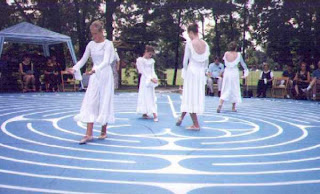
Recently, the CLP office has been abuzz with a host of concerned e-mails and phone calls regarding the incorporation of the labyrinth in "occult" rituals. I have personally contacted many of you who have written in with questions such as "Are labyrinths Satanic?" or "Why do wiccans love labyrinths?" or "Is a massive stone labyrinth in Paul Brown Staidum offensive to my Christian/Moslem belief structure?"
This is a subject on which much has been written, but for purposes of brevity, I will attempt to answer these questions as succinctly as possible.
Sunday, December 7, 2008
What does all this mean to us?
As may be obvious to you, dear reader, we've heard a great deal about labyrinth scholarship in the past few days. While this is all useful information in terms of understanding the labyrinth and its place in history, it also seems to be distracting us from what this whole project is about: the proposed Cincinnati labyrinth. While the words of Stalle, Dedal, Smallencroft, etc. tell us a great deal about the Labyrinth as an entity, they also leave behind the true purpose of our work. I'd like to take this post to examine what a “state of the art” labyrinth is, and what it would mean to the city.
Now, before we start, I feel the need to clarify my definition of "labyrinth." For the purposes of this project, and I'm sure my colleagues would agree, we are subscribing to the classical definition of labyrinth, meaning it is not easily distinguishable from a maze. In more recent years the labyrinth has taken on a different meaning, used more as a means of spiritual meditation. In the modern labyrinth, the participant walks along one path until the end. There are no decisions to be made and it is impossible to become lost within in it. The Cincinnati Labyrinth would not follow the modern, 2D prescription for labyrinths, rather we would like to see a return to the intricate structures, dead ends and tricks that were originally intended to solve King Minos's Minotaur problem.
Initially mentioned in our mission statement, this labyrinth would be "state of the art." If it is truly to become a tourist destination we can't have families becoming forever lost within its cavernous walls. We hope that people would truly attempt to finish their journey, but just in case highly skilled labyrinth technicians would monitor the structure constantly. These are people who have intimate knowledge of the structure and who will be able to direct hopelessly lost maze-walkers in the correct direction should the need arise via ear pieces worn by each attendee and CCTV cameras stationed liberally throughout the labyrinth. In addition to these "Watchers," highly visible panic buttons would be strategically placed at recognized trouble points in the labyrinth.
With these security measures in place, the Cincinnati Labyrinth is poised to become a feather in the cap of the Queen City. No longer will we carry the shame of a sub-par football squad. We need something contained within the walls of Paul Brown Stadium that we can be proud of. Nobody likes taking visitors to see a losing football team. With a labyrinth taking the Bengals place, this problem will become a thing of the past. A labyrinth never loses, never embarrasses a city and certainly cannot be arrested. The only "building years" will be during its construction. After that Paul Brown Stadium will be a house of victory for all of its existence.
In this modern age of constant consumption and fleeting trends there are very few things that are built to last forever. No structure we build in this age will have the ability to stand as long as something like the Coliseum or the Parthenon. This is why building something like this would set us apart from every other city in the United States. The labyrinth says to the world that Cincinnati is not just concerned with its present but also with its lasting legacy. Cincinnati is not just "now," but also for the ages.
As we asked before, please sign the petition. Do it for Cincinnati, for our future, for our reputation and, as always, do it for labyrinths.
Toward a Textual Understanding of the Labyrinth: Some Literary Precedents
First appearing in the
“She started to run straight forward, and then turned like lightning and sped back the way she had come, enveloped in a sudden icy terror.
She had reached a turn – was it here? – took the left and came to what should have been the outlet into the long, low room, but it was only another glittering passage with darkness at the end.” (67)
While the narrative description of Sally’s “terror” continues beyond the above passage, the significance here is obviously metaphorical. Ill-equipped to assimilate herself into the shockingly “hard” world of the Northern gentry, Sally loses consciousness within the labyrinth and (perhaps more significantly) is finally rescued by a professor of literature (not her fiancĂ©). What I would like to point out is the problematic commentary on endings that Fitzgerald provides in this story. The labyrinth functions as the telos of Sally’s Northern journey. It marks the endgame of her failed engagement (to say nothing of the telos implicit in the labyrinth itself [see Gollensten’s culte du centre]).
Literary grapplings with the labyrinth are not always as successfully nuanced as what we see in Fitzgerald, however. I would argue that Stephen King’s incorporation of the hedge-labyrinth at the end of *The Shining* is something of a red herring, a confusing and overly symbolic prop that leaves the reader/viewer wondering why he doesn’t just tear through the shrubs with his axe.
To be sure, literary appropriations of the labyrinth are not merely relegated to the phenomenon of modernity. Critics often utilize descriptors such as “labyrinthine” to describe the fundamentally meandering prose of postmodernists like Pynchon, Gaddis, and (more recently) Wallace. Though studies on the influence of the labyrinth in textual discourse are in their infancy, I think we can all agree that labyrinths allow us a unique access to the “roots/routes” dichotomy of our cultural inheritance.
Fitzgerald, F. Scott. “The
Friday, December 5, 2008
Cincinnati Labyrinth Project Petition
Petition statement:
Cincinnati is in need of a cultural and economic renaissance. By signing this petition, you express your commitment to the notion that by selling the perennially unsuccessful, infuriatingly mediocre Cincinnati Bengals football franchise and erecting a complex, state-of-the-art stone labyrinth in Paul Brown Stadium, all Cincinnatians would experience both fiscal and cultural growth. We at the Cincinnati Labyrinth Project are a deeply committed bunch, so you may rest assured that we will work tirelessly to bring this wonderful proposal to fruition. Do it for Cincinnati! Do it for labyrinths!
The Project
Thanks for your interest in the Cincinnati Labyrinth Project! For those of you who are unfamiliar with our organization, please allow me to bring you up to speed. The CLP is a group of enterprising Cincinnati locals who are endeavoring to bring about one of the biggest, most fascinating, and, most importantly, one of the most lucrative changes to Cincinnati culture in decades.
Our goal is to facilitate the sale of the Cincinnati Bengals and the creation of a massive stone labyrinth in Paul Brown Stadium.
Stay tuned for more updates and details to come henceforth.